Yude
Mechanical
Yude
Mechanical
In mining crushing, building aggregate production, and industrial raw material processing, jaw crushers consistently play the role of "core primary crushing equipment." When selecting and optimizing equipment operating parameters, companies often focus on a key indicator—the crushing ratio. However, many users' understanding of the crushing ratio in practical applications remains superficial, with inconsistencies in calculation methods and inaccurate data sources. This directly impacts equipment selection, capacity assessment, and production cost control.
This article will focus on a "Jaw Crusher Crushing Ratio Calculation Guide," providing a systematic explanation from the aspects of definition, calculation methods, practical applications, and influencing factors to help enterprise users make more scientific decisions in actual production.
The crushing ratio is an important indicator for measuring the performance of a jaw crusher. It represents the degree of particle size change of the material before and after crushing. Simply put, the larger the crushing ratio, the greater the reduction in particle size that the equipment can achieve in a single crushing operation.
In engineering practice, the crushing ratio not only affects the processing capacity of the equipment but also directly relates to the working efficiency of subsequent equipment (such as cone crushers, impact crushers, and sand making machines). Therefore, properly calculating and controlling the crushing ratio is a crucial step in optimizing the entire production line.
Different operating conditions and data sources will correspond to different calculation methods. The following three methods are the most common and valuable in the industry:
1. Max Size Method
This is the most intuitive calculation method:
Crushing Ratio = Maximum Feed Size ÷ Maximum Discharge Size
For example:
Maximum feed size is 600 mm
Maximum discharge size is 100 mm
Then the crushing ratio = 600 ÷ 100 = 6
This method is suitable for the equipment selection stage, but because it only considers extreme values, its reference value in actual production is limited.
2. Average Size Method
This method more closely reflects actual production conditions:
Crushing Ratio = Average Feed Size ÷ Average Output Size
For example:
Average feed size is 300 mm
Average output size is 50 mm
Then the crushing ratio = 300 ÷ 50 = 6
This method better reflects the overall crushing capacity of the equipment and is suitable for production data analysis and optimization.
3. 80% Through Size Method (P80 Method)
This is a more professional calculation method in the mining industry:
Crushing Ratio = F80 ÷ P80
Where:
F80: 80% through feed size
P80: 80% through output size
For example:
F80 = 500 mm
P80 = 80 mm
Then the crushing ratio = 500 ÷ 80 ≈ 6.25
This method provides more stable data and is suitable for large-scale mining projects and refined management.
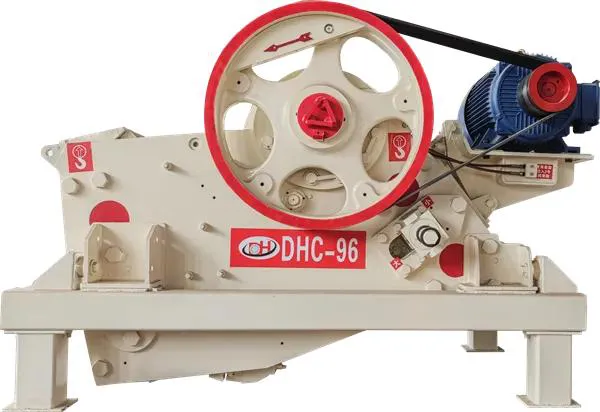
When selecting a jaw crusher, companies need to understand the typical crushing capacity of different structural equipment:
Coarse Jaw Crusher: 3 – 6
Medium Jaw Crusher: 5 – 8
Fine Jaw Crusher: 8 – 10 The actual crushing ratio is affected by factors such as material hardness, moisture content, and mud content; therefore, there is usually a deviation between the theoretical and actual values.
In actual production, if a company finds that the crushing ratio does not meet expectations, it can usually check the following aspects:
1. Material Characteristics
Materials with high hardness (such as granite and basalt) are generally difficult to achieve a high crushing ratio, while medium- to low-hardness materials such as limestone are easier to achieve the desired effect.
2. Feed Particle Size
If the feed particle size fluctuates greatly, the crushing ratio will be significantly unstable. Therefore, a stable feeding system (such as a vibrating feeder) is crucial.
3. Discharge Opening Settings (CSS)
The smaller the discharge opening, the finer the output particle size, and the larger the crushing ratio. However, an excessively small discharge opening will increase the equipment load and may even lead to material blockage or accelerated wear.
4. Equipment Structure and Parameters
Different models of jaw crushers differ in their moving jaw stroke, speed, and cavity design, all of which directly affect the crushing effect.
5. Operation and Maintenance
If operators do not adjust and maintain the equipment according to standard procedures, it will lead to a decline in equipment performance, thus affecting the crushing ratio.
If enterprises wish to improve crushing efficiency while ensuring production capacity, they can start from the following aspects:
1. Reasonable Control of Feed
Stable feed particle size and flow rate can significantly improve crushing efficiency and reduce equipment fluctuations.
2. Optimize Discharge Opening Settings
Enterprises should dynamically adjust the discharge opening size according to the needs of downstream equipment, rather than blindly pursuing smaller output.
3. Adopt a Staged Crushing Process
If a single piece of equipment cannot meet the crushing ratio requirements, a combination of "jaw crusher + cone crusher" or "jaw crusher + impact crusher" can be used.
4. Regular Maintenance of Key Components
Wear of components such as the moving jaw plate, fixed jaw plate, and bearings directly affects crushing efficiency. Enterprises should establish a periodic inspection mechanism.
5. Introduction of Data Monitoring Systems
Modern mines increasingly favor intelligent monitoring systems to analyze feed particle size, output particle size, and load conditions in real time, thereby dynamically optimizing the crushing ratio.
Many enterprises focus only on output, neglecting the impact of the crushing ratio on costs. In fact, a reasonable crushing ratio can bring the following benefits:
Reduced secondary crushing load
Reduced equipment wear
Improved overall line operating efficiency
Reduced unit energy consumption
If the crushing ratio is not designed reasonably, enterprises may face problems such as equipment overload, increased energy consumption, and increased maintenance costs.
Q1: Is a higher crushing ratio always better?
No. An excessively high crushing ratio may lead to excessive equipment load, thereby reducing service life.
Q2: How to quickly determine if the crushing ratio is reasonable?
Enterprises can compare the design value with the actual output particle size distribution. If the deviation is large, the parameter settings need to be re-evaluated.
Q3: Can the crushing ratio be changed by adjusting the rotation speed?
Rotation speed affects crushing efficiency, but it is not the core factor determining the crushing ratio. Adjustments should be made with caution.
The crushing ratio of a jaw crusher is not just a simple calculated indicator; it actually reflects the operating efficiency and design rationality of the entire crushing system. Enterprises that correctly understand and scientifically apply the crushing ratio calculation method can gain significant advantages in equipment selection, production optimization, and cost control.
In the current trend of digitalization and intelligentization, enterprises can further improve the stability and efficiency of their crushing systems through data analysis and automated control, thereby gaining a competitive edge in the fierce market.
If you are seeking more professional support for selecting or optimizing a crushing production line, it is recommended to conduct system analysis based on actual operating data, rather than relying solely on theoretical values. Only by combining theory and practice can the goals of efficient, stable, and low-cost production be truly achieved.
Top 3 Jaw Crusher Mistakes That Kill Your Production Rate
2026-07-20 02:40How Often Should You Replace Jaw Plates for Maximum Uptime?
2026-07-13 02:40Achieve Consistent 1-Inch Minus with These Jaw Crusher Settings
2026-06-29 06:06The Secret to Lower Energy Bills in Jaw Crushing Operations
2026-06-22 02:40Address: Luoyang Luoxin Industrial Park, Henan,China
E-mail: sales@yd-crusher.com
Phone: 86-139-3993-0123
Yude
Mechanical
Create the greatest value for customers
Provide the best quality products and services
86-139-3993-0123
sales@yd-crusher.com
Luoyang Luoxin Industrial Park, Henan,China